
kirana stores shut since quick commerce took off, as estimated by the distributors' federation AICPDF. It is an industry estimate that quick-commerce companies dispute.1
Built in Hyderabad · Telangana · for India
One app for your city that keeps local shops alive.
VishvSaathi brings the kirana, clothing and electronics shops already on your street online, instead of replacing them with dark stores. The same app gives drivers more work at fair fees, and helps verified hospitals reach blood donors, with free rides for every donor.
- 🏪 Local shops
- 🥬 Kirana groceries
- 🍛 Food
- 🛺 Rides
- 🧑🤝🧑 Seat Share
- 📦 Parcels
- 🩸 Blood donation
- 🍱 Leftover food
Pre-launch · product built, pilot in preparation
Launch city · Hyderabad
Built on · Cloudflare · Google Cloud & Firebase · Claude Code
The problems
What is going wrong in Indian cities today
These are reported figures, with sources listed at the bottom of this page. Some come from industry bodies and are their estimates.
dark stores planned by one quick-commerce company alone by March 2027, up from 1,816 in September 2025 (CBRE, India Logistics Market Outlook 2026).2
rise in a year in the rent for street shop space where dark stores open, because they pay 30–40% more than a kirana can afford (April 2026).2
of the Mumbai grocery stores in a J.P. Morgan study reported falling sales, mostly blamed on quick commerce.2
gig and platform workers in Telangana joined the 22 July 2026 strike, asking for fare revision, lower commissions and a welfare board.3
app-taxi users have faced dark patterns or hidden charges, according to a LocalCircles survey of 94,000 users (November 2025).4
to travel 10 km in Hyderabad, with about 123 hours lost per commuter in a year (TomTom Traffic Index 2025, released January 2026).5
urban women feel unsafe in their city, according to the National Commission for Women's NARI 2025 report.6
of India's population lives in states that are effectively "blood deserts", despite record collection. About 6.5 lakh units are wasted every year (March 2026).7
is how long blood stocks at several Nagpur blood banks could last in May 2026, as camps and voluntary donors fell. A Mumbai hospital reported the same shortage.8
children in India live with thalassemia major and need a transfusion every few weeks, for life. Families still search for donors through WhatsApp forwards.9
of food is wasted in India every year, the second most in the world. Restaurants and other food services cause about 28% of it (UNEP Food Waste Index).10
How VishvSaathi answers each problem
Problem
🏪 Dark stores take business away from local shops
Quick-commerce companies build their own warehouses (dark stores). The kirana owner down the road loses regular customers and has no way to compete on delivery.
VishvSaathi
We bring the existing shop online
No dark stores and no stock of our own. Orders go to the real shops near the customer, and our drivers or the shop's own staff deliver. The shop keeps its customers and gets new ones.
Problem
🛺 Drivers pay high cuts and sit idle between trips
Percentage commissions eat into every fare, and a ride-only driver waits empty between bookings.
VishvSaathi
Fair fees and more jobs from one app
A small flat fee or daily pass, with the driver keeping at least 80% as the 2025 central guidelines require.11 One driver can take rides, food, grocery, shop and parcel jobs, and combine orders on the way.
Problem
🩸 Finding blood depends on luck and forwards
Families post on WhatsApp, donors cannot reach the hospital quickly, and blood is short in some districts while it expires in others.
VishvSaathi
Verified requests, matched donors, a paid ride
Only verified hospitals raise requests. We alert matching donors nearby, send a bike to take them to the hospital at the normal bike fare, and book their ride home. Both are paid for, so the donor pays nothing. We also help licensed blood centres move spare units to where they are needed.
Problem
🍱 Good food is thrown away every night
Restaurants cook extra food that is still fresh at closing time. It goes in the bin while drivers, shelters and families nearby go hungry.
VishvSaathi
A "Left food" button for every restaurant
The restaurant taps Left food and enters the quantity. The food goes free to a hungry driver, a verified NGO or a care centre such as an orphanage or old-age home. It is never sold.
Problem
💸 Hidden charges and changing prices
The price at booking is not always the price paid, and extra charges appear without explanation.
VishvSaathi
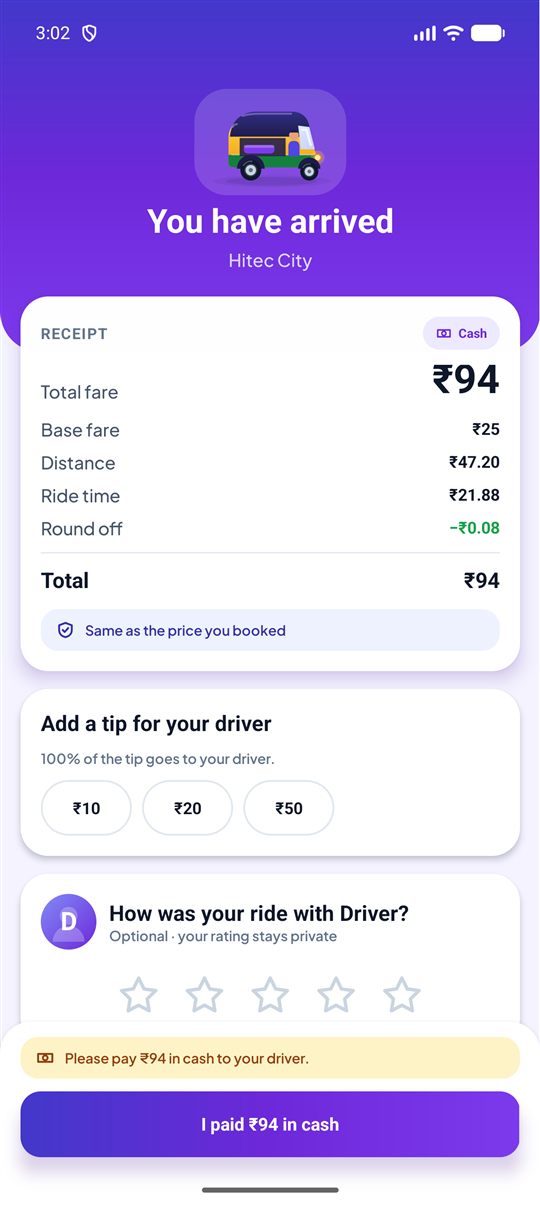
Fare locked at booking, every rupee shown
Our server calculates and locks the price before you book. The receipt lists every line. A modified app cannot change a price.
Problem
🚕 Commuting is slow and expensive
A solo auto or cab to the office every day costs too much, and the roads are full of half-empty vehicles.
VishvSaathi
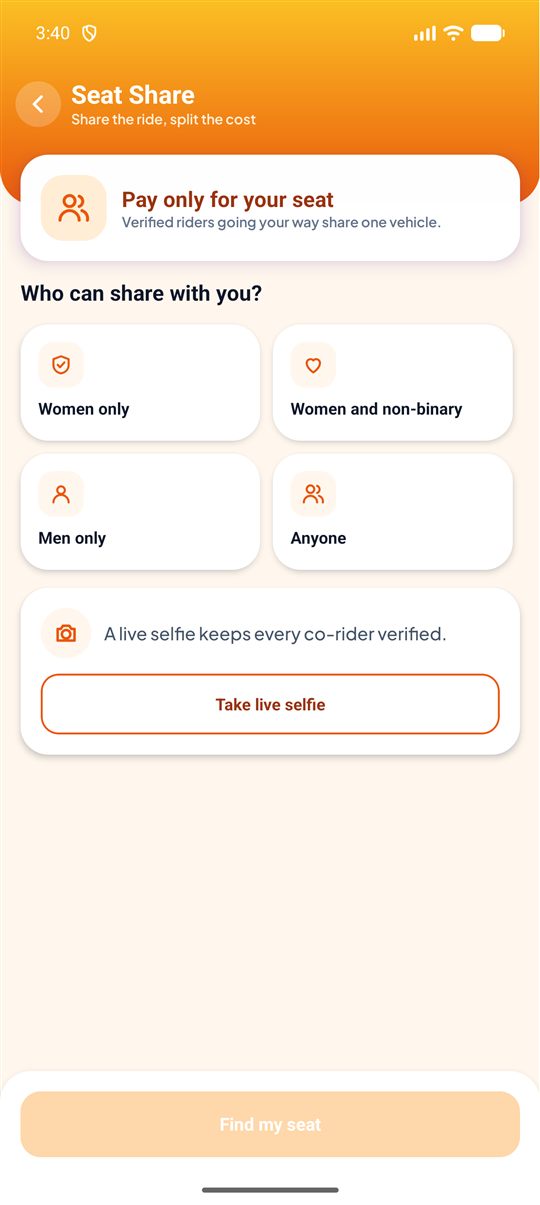
Seat Share for daily routes
Verified riders going the same way share one vehicle and pay only for their seat. First routes planned: KPHB–HITEC City, LB Nagar–Ameerpet and Secunderabad–Gachibowli.
Problem
🛡️ Safety and privacy are afterthoughts
Riders worry about sharing their number and getting help fast. Personal data is shared too widely.
VishvSaathi
Safety and privacy built in
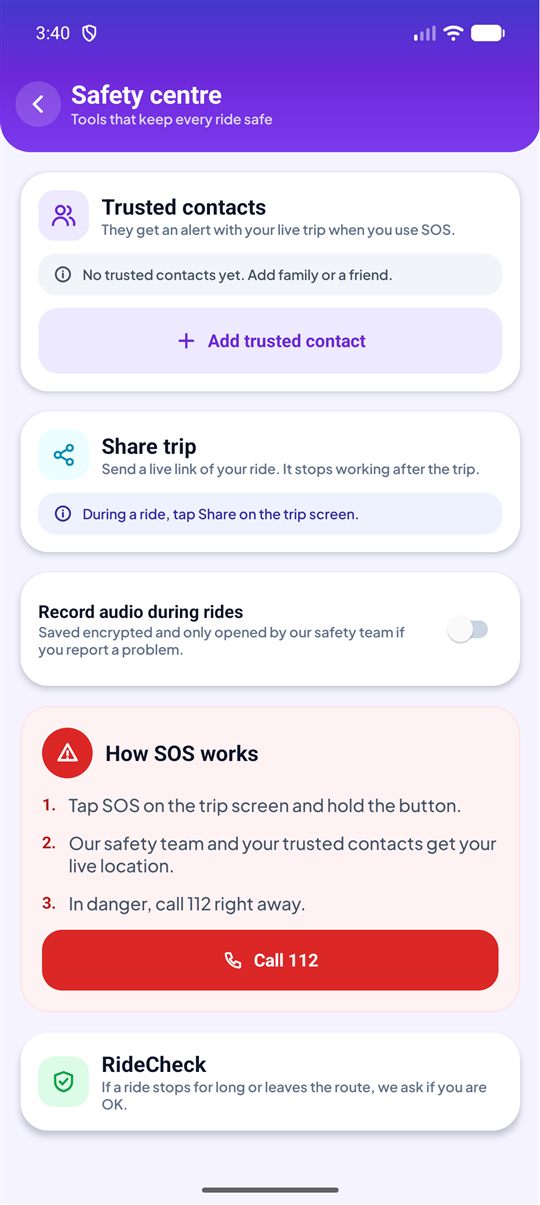
SOS, "Are you OK?" checks, trip sharing, masked calls, a woman-driver option, and consent, data export and delete as India's DPDP Act requires.
For local shops and kiranas
The shop on your street stays in business.
A kirana owner opens at 7 in the morning and closes at 10 at night. The shop is their family's income, and often their home. When a dark store opens nearby with 10-minute delivery, that shop cannot compete. VishvSaathi does not open dark stores. We give the existing shop the same reach.
- No dark stores, no stock of our own. Every order is filled by a real local shop near the customer.
- Delivery handled. Our drivers deliver, or the shop delivers with its own staff and keeps the delivery fee.
- Fair, clear commission. A percentage of MRP set per category, shown on every statement. Any change needs two admins to approve it.
- Paid the next working day, with GST, TCS and TDS worked out on every statement.
- Simple tools. Scan items while packing, mark out-of-stock, and let the customer choose a replacement in 2 minutes.
- Trust built in. FSSAI and other licences checked per category; listings pause automatically if a licence expires.
Dark-store quick commerceVishvSaathi
Who holds the stockThe platform's own warehouseExisting local shops
What happens to the kiranaLoses customersGets online orders
Who earns from the saleThe platformThe shop owner, minus a clear commission
Product rangeWhat fits in a warehouseGroceries, clothes, electronics, books, home and more
For drivers
More work in a day, and a bigger share of every rupee.
A ride-only driver earns only when someone books a ride. On VishvSaathi, the same driver can deliver food, groceries, shop orders and parcels between rides, so less of the day is spent waiting.
One driver, every service
Rides, Seat Share, food, groceries, local-shop orders and parcels come through the same driver app. Drivers choose which jobs they accept.
Combine orders on the way
A driver can carry up to 3 orders going the same way, within a 1.5 km detour. Each order pays its full amount plus a ₹10 bonus for each extra order. Passengers are never delayed by more than 5 minutes.
Going My Way
Heading home or to another area? Set the destination and get only jobs on the way, so the trip back earns money too.
Fair fee options
A daily pass (for example ₹25 for an auto) with no commission, or a small flat fee per ride. The app shows the cheaper option. Drivers keep at least 80% of the fare, as the 2025 guidelines require.
No penalty for skipping
Skipping a combined order costs nothing. Tips go 100% to the driver, and earnings are shown after every trip.
Blood trips first
Blood donor rides always get priority. A donor ride pays the normal bike fare, the same as any other bike trip, so a driver never loses money by taking one.
In our dispatch simulation (240 combined trips), the longest extra wait for any passenger was 268 seconds, under the 5-minute limit, and every blood request was served first.
Blood donation
A blood network built into a city app, and never run for profit.
Blood cannot be sold, and donors must donate voluntarily. So donors never pay anything and never receive coins or rewards. What we add is speed: verified requests, matched donors, a bike ride to the hospital at the normal bike fare, and a ride home, both paid for the donor.
- 1. Verified hospital raises a request
Only staff of a hospital we have verified can ask for blood: group, units and urgency. No patient name or diagnosis is ever entered.
- 2. Matching donors are alerted
Exact group first, then compatible groups, searching 5, 10 and 20 km. For rare groups, every matching donor is alerted at once.
- 3. Donor accepts and is checked
Age, weight and the gap since last donation (90 days for men, 120 for women) are checked, plus a short health checklist.
- 4. Bike ride to the hospital
A bike driver picks the donor up with an OTP. The trip costs the same as a normal bike ride, and that fare is paid for the donor. The donor pays ₹0.
- 5. Ride home and a certificate
One tap books the ride home, also paid for, so the donor pays nothing either way. The donor gets a digital certificate and badges, never money.
🏥 Hospital to hospital transfers
Licensed blood centres can move spare units to another centre within 50 km. Every unit is barcode-scanned and its temperature logged. The hospital's own cold-chain vehicle carries the blood, never our drivers.
🛟 Works when everything else fails
Blood requests run on their own lane. If our main database or other services go down, requests keep working, and a fallback can alert nearby donors by SMS.
💛 Donors are protected
At most 3 alerts a day, quiet hours at night unless a donor opts in, one request at a time, and a "never pay anyone for blood" warning in the app.
🧒 Thalassemia donor circles
Groups of 8–10 donors take turns every 15–20 days for a child who needs regular transfusions, so no single family has to search every month.
🔎 Rare blood
Rare groups are searched across the state, with links to national registries such as e-RaktKosh.
🏕️ Donation camps
Licensed blood centres can register camps. Donors book a slot and get reminders and certificates.
Leftover food
Good food goes to people, not to the bin.
Restaurants often have fresh food left when the day ends. With one button, they can give it away free. Food rescued through VishvSaathi is never sold, and the restaurant never pays to give it.
- 1Restaurant taps "Left food"
It enters what the food is and the quantity, when it was cooked and a pickup-by time, and ticks a food-safety check (sealed, not reheated).
- 2Our server checks it
Food that has been sitting too long cannot be listed. The time limit is set by our admin team, not by the app.
- 3It is offered to the nearest taker
A verified NGO or care centre that needs food, a driver nearby, or a registered community fridge.
- 4Picked up and handed over
The driver collects it with an OTP and a photo. The NGO or care centre confirms with an OTP when it arrives.
A free meal for drivers
A driver near the restaurant can claim the food for their own meal, a few times a day, or carry it to someone in need with a photo of the handover (no faces).
NGOs and care centres
Verified NGOs, shelters, orphanages and old-age homes post how much food they can take. The nearest one with space is offered the food first.
Credit for the restaurant
The restaurant gets a donation certificate and a "Food Hero" badge, and a monthly report of how many meals it saved.
Food is never sold through this feature. Anyone caught selling rescued food can be reported and is removed from the platform.
The product
One login. One wallet of coins. Every service a city needs.
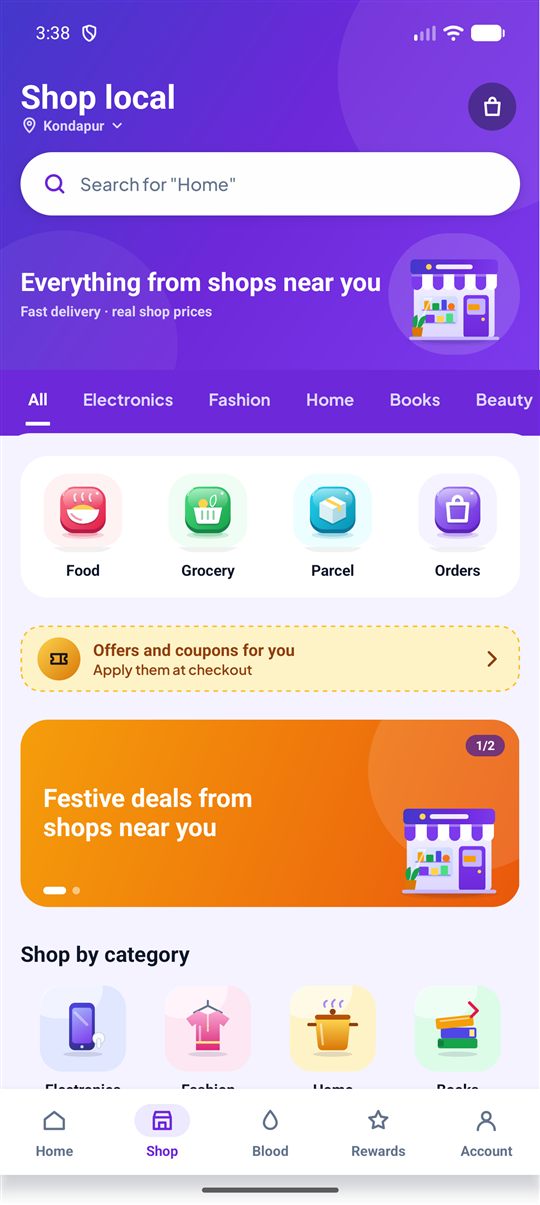
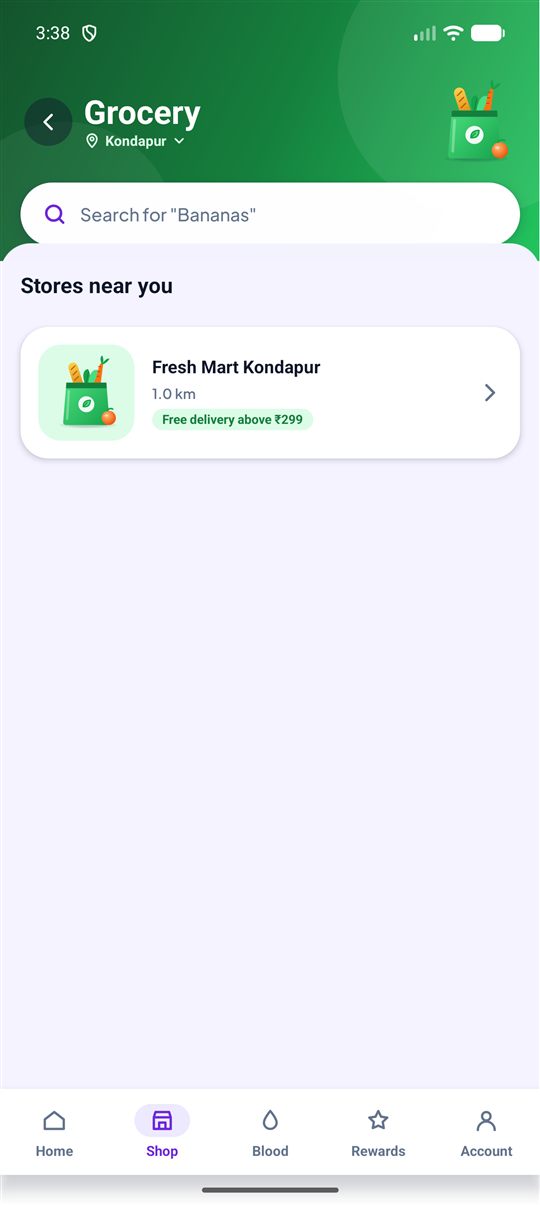
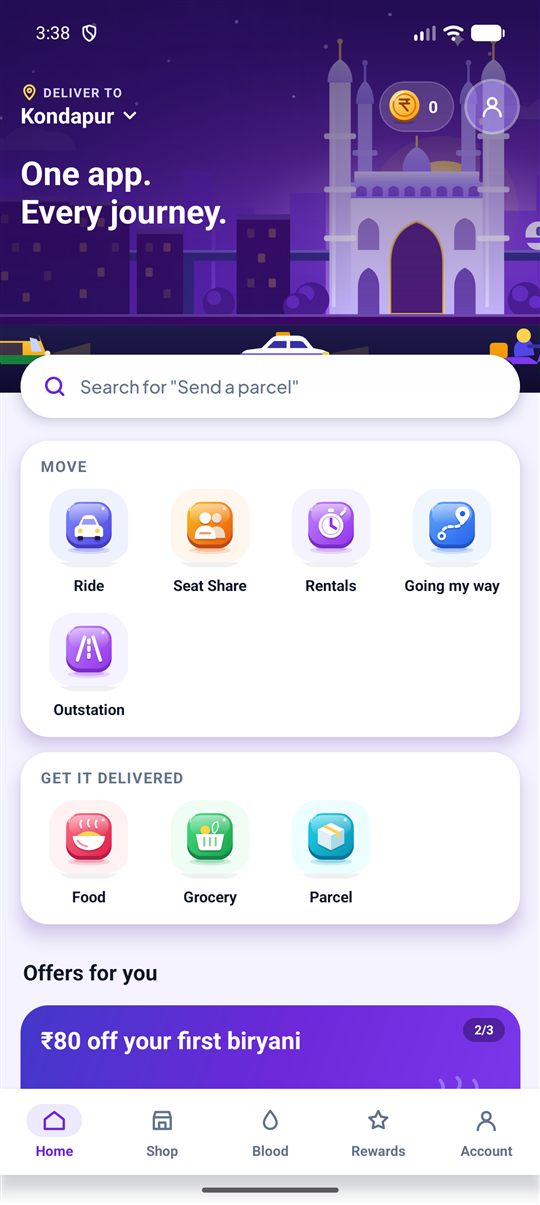
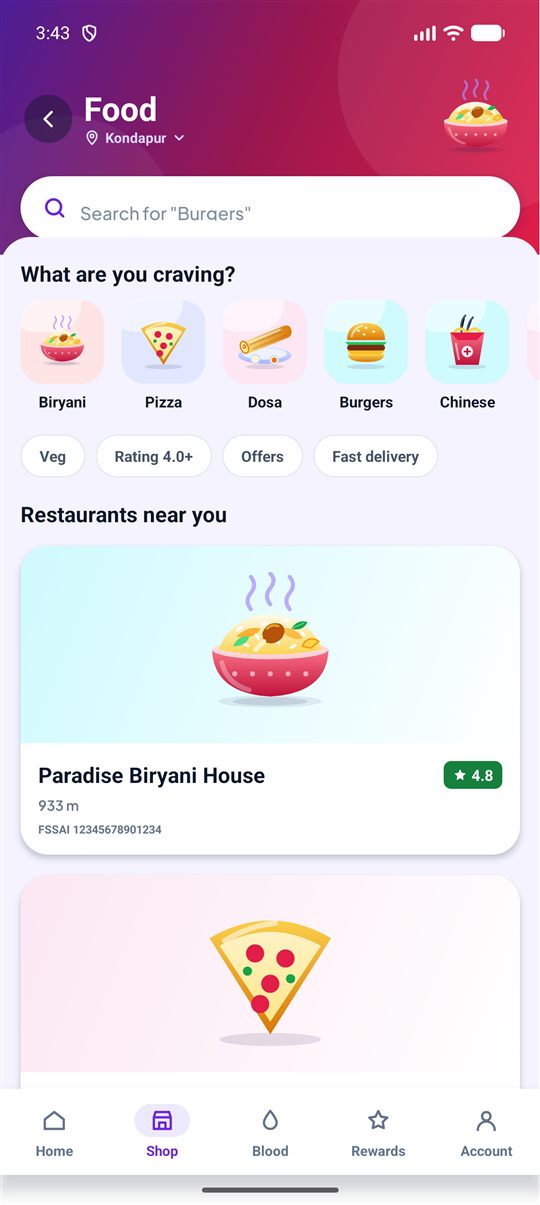
These are real screens from our working Android app, running against our own backend with demo data. They are not mock-ups.
Home: everything in one place
Your delivery spot at the top, then every service grouped as Move and Get it delivered. Offers come from the admin panel, never from the code.
Local shops, online
Electronics, fashion, home, books, beauty and sports from shops already in your area, with real MRP and the shop's own price.
Groceries from your kirana
Order from a neighbourhood store, pick a delivery time, and choose what happens if an item is out of stock.
Food from nearby restaurants
Cuisines, veg filter, ratings and the FSSAI licence number of every restaurant. Size and add-ons are priced by our server.
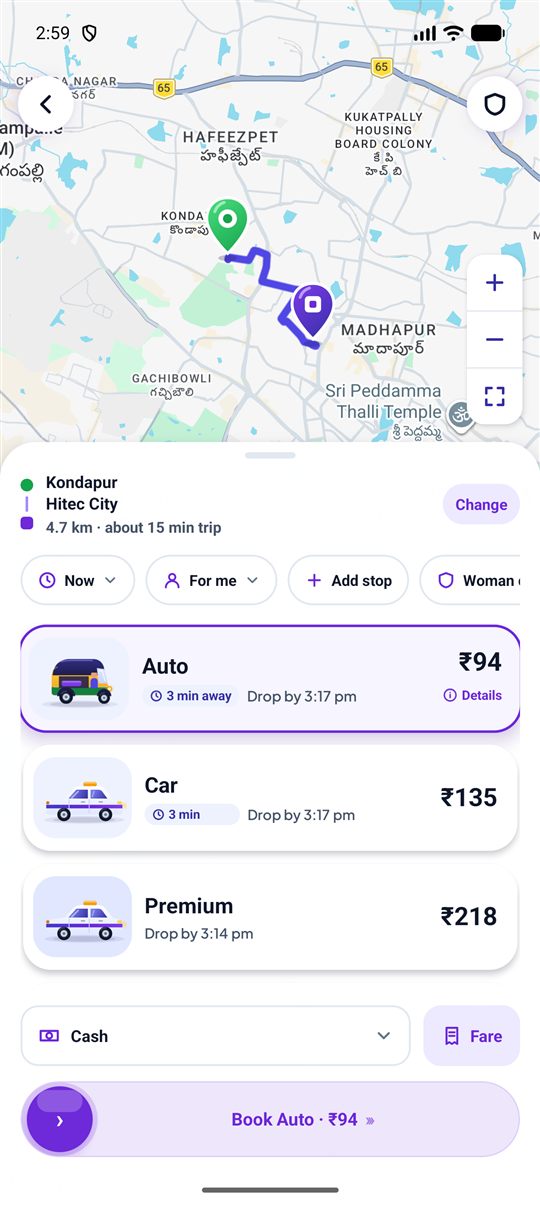
Rides: auto, car and premium
Real road distance and time, a drop-by time, a woman-driver option, and a fare locked when you book.
Seat Share: pay only for your seat
Choose who can share with you; a live selfie verifies every co-rider.
Safety centre
Trusted contacts, trip sharing, SOS that reaches our safety team, and ride checks.
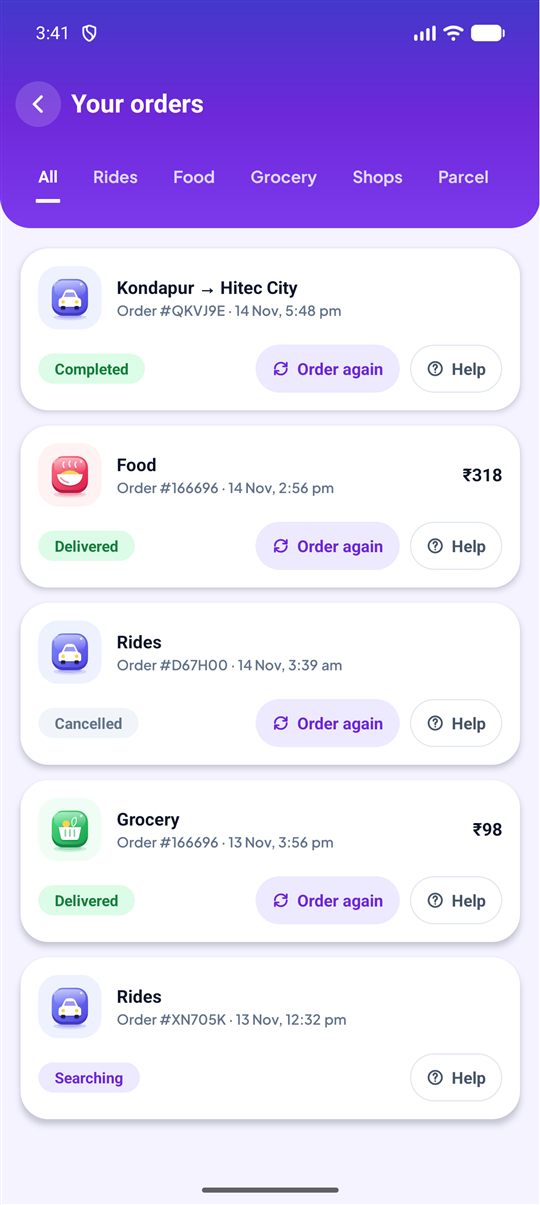
All your orders, one list
Rides, food, groceries, shops and parcels together, with order again, help and ratings.
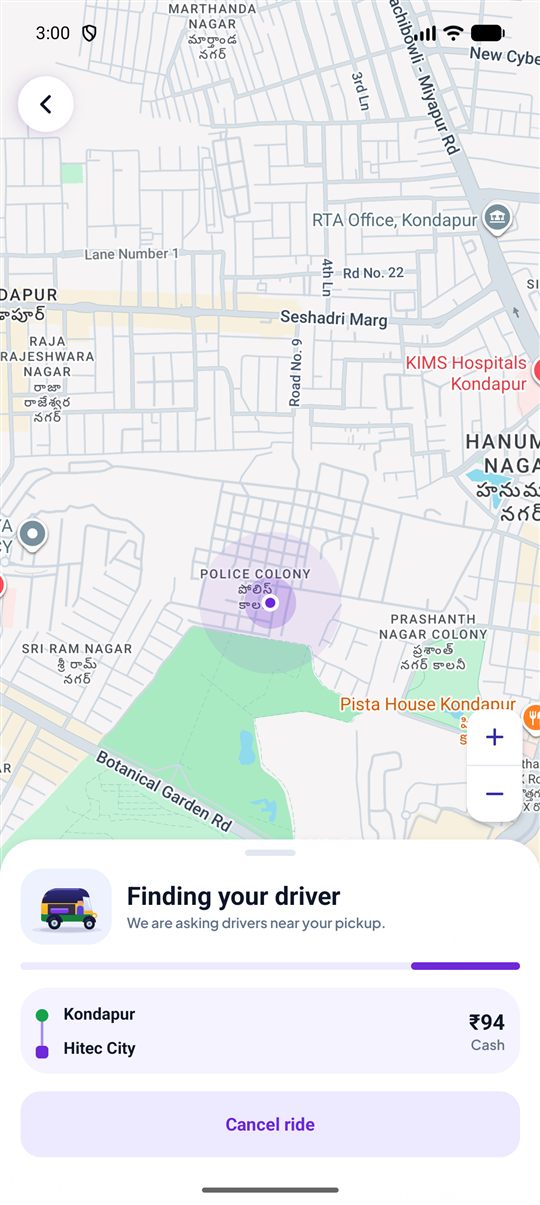
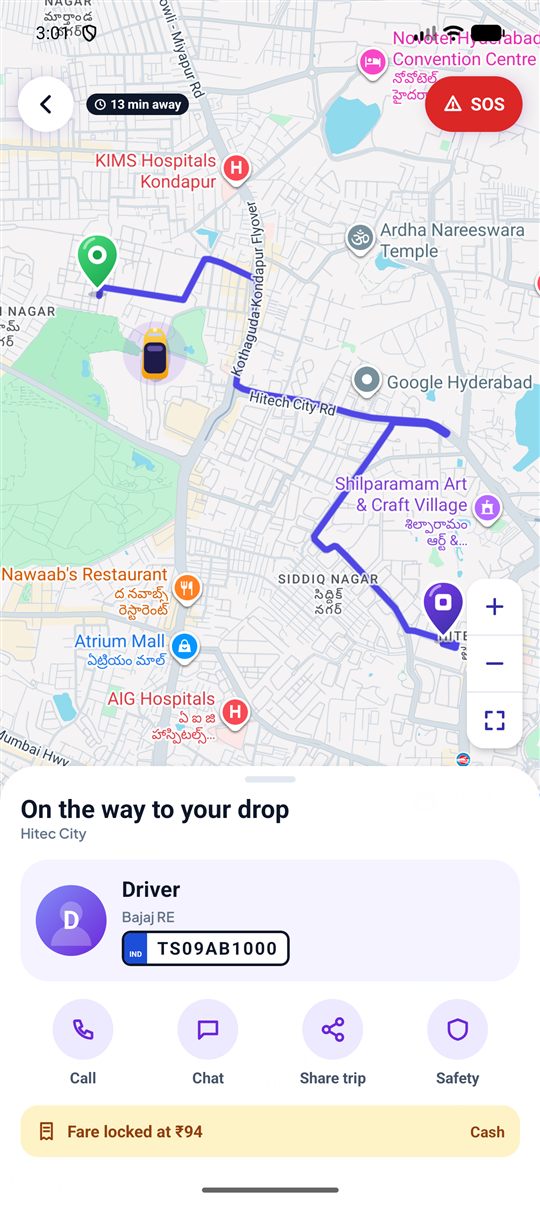
A real ride, end to end
From booking to receipt in four screens.
Recorded on our test device: Kondapur to Hitec City, paid in cash. The driver side ran on our own driver API.
Business model
How VishvSaathi earns, fairly.
Shops and restaurants
A commission as a percentage of MRP, set openly per category, plus a small platform fee per order.
Drivers
A daily pass or a small flat fee per ride, never more than 20% of the fare.
Deliveries and businesses
Delivery fees on orders and parcels, and a delivery API for local businesses.
Hospitals
Monthly billing for donor pickup rides and coordination only. We never charge for blood.
Sponsored listings
Shops can promote products, always clearly marked "Sponsored".
Rentals and outstation
Hourly rentals, city tours and city-to-city trips.
Technology
Built for 1 lakh orders a day at launch, and designed to grow.
The system is built in stages. Stage 1 handles 1 lakh orders a day; later stages scale the same design up to crores of users a day without a rewrite.
Apps
Customer appDriver appShop partner appHospital consoleAdmin console
Cloudflare: edge, real time and storage
WAF, rate limits and DDoS protectionTurnstile bot checksZero Trust for the admin consoleWorkers APIDurable Objects for live trips, orders and dispatchQueues with a separate blood laneD1 database · KV cacheR2 storage: shop and food photos, invoices, delivery proof, backups
Google Cloud and Firebase: identity, data, maps
Identity Platform: a separate login per appFirestore in Mumbai (asia-south1), backup in DelhiFirebase Storage: private KYC, licences and selfiesGoogle Maps Platform: routes and placesCloud Messaging
Claude by Anthropic
Claude Code: building featuresClaude Code: writing and running testsClaude Code: debuggingClaude Code: security and code reviewsPlanned: support assistant in Telugu, Hindi and EnglishPlanned: operations copilot for admins
0apps and consoles built
0automated tests
0languages: English, Telugu, Hindi
0services in one app
- Every price, fee, radius and timer is an admin setting, and sensitive changes need a second admin to approve.
- Prices and payments are decided on the server, so a modified app cannot change them.
- A full internal security, money and privacy audit in November 2026: every high-severity finding fixed.
- Double-entry money ledger, daily backups with point-in-time recovery, and an audit log of admin actions.
Where we are
Built, tested, and preparing a Hyderabad pilot.
- Built
Customer, driver, shop partner, hospital and admin apps, the backend, security reviews, and a live ride tested end to end on a device.
- Now
Preparing the Hyderabad pilot: onboarding local shops, restaurants, drivers and 2–3 hospitals with licensed blood centres around Kondapur, Gachibowli and Madhapur.
- Next
Public launch in Hyderabad with Seat Share on busy office routes, then other Telangana cities.
- Later
More Indian cities, city-to-city trips and a delivery API for local businesses.
How cloud credits help us
Every credit goes into the platform we are already building.
Cloudflare
Workers Paid for scheduled jobs, Analytics Engine, Durable Objects at scale, and a staging environment for the pilot.
R2 storage for shop and food photos, invoices, delivery proof photos and backups.
Google Cloud and Firebase
Firestore and Identity Platform for every user, Google Maps routes and places for accurate fares and ETAs, and Cloud Messaging for live updates.
Firebase Storage for private files: driver licences, KYC documents and verification selfies, kept in India.
Claude
A support assistant that answers in Telugu, Hindi and English and hands hard cases to a person.
Claude Code to build features, write and run tests, debug and review code across our backend and five apps.
Partner with us.
We are talking to local shops, restaurants, drivers, hospitals and investors in Hyderabad.
Email: coming soonSources
- AICPDF estimate, reported by Business Standard, 30 Oct 2024: "Quick commerce led to closure of 200,000 kirana stores". Industry body estimate; quick-commerce companies dispute it.
- Upstox, 28 Apr 2026 (opinion piece by Anupam Jain): "Dark stores are pricing the neighborhood kirana store out of its own street". Cites CBRE's India Logistics Market Outlook 2026 for dark-store counts and a J.P. Morgan study of 50 Mumbai grocery stores.
- Telangana Today: "Telangana App-Based Drivers announce strike over pending demands on July 22"; Hyderabad Mail: statewide strike on 22 July 2026 (worker count); Siasat: "Telangana gig workers to begin indefinite strike on Aug 8".
- LocalCircles survey, reported by Business Standard, Nov 2025: dark patterns and hidden charges in ride-hailing.
- TomTom Traffic Index 2025, Hyderabad: tomtom.com/traffic-index; Siasat: "Hyderabadis spend 123 hrs on roads".
- National Commission for Women, NARI 2025 report, Aug 2025.
- Newslaundry, 2 Mar 2026: "Govt claims it is blood-sufficient. But is it?"; ORF: "Securing India's lifeblood".
- The Hitavada, 18 May 2026: "City facing blood shortage crisis as pvt blood banks don't have adequate stock" (Nagpur); Free Press Journal: "Sion Hospital blood bank faces shortage as donations drop" (6,817 units, Jan–Jun 2026).
- IndiaSpend: "Thalassemia children navigate depleted blood supply" (government estimate of children with thalassemia major).
- UNEP Food Waste Index Report 2024, summarised by Drishti IAS: "India's food waste conundrum".
- Motor Vehicle Aggregator Guidelines 2025, Ministry of Road Transport and Highways (driver share and fare rules).